Vertical TMR Feed Mixer for Sale in South Africa
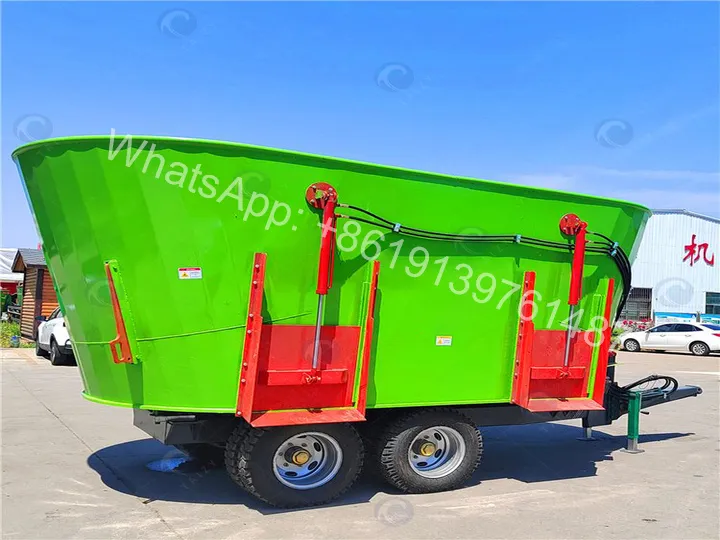
If you are searching for a vertical TMR feed mixer for sale in South Africa, you are probably running a dairy farm, beef feedlot, or sheep operation and want to cut feed waste, save labor, and improve animal performance. A vertical TMR feed mixer chops and blends silage, hay, straw, concentrate, minerals, and additives into one uniform Total Mixed Ration. The result is a balanced feed that prevents selective eating and supports higher milk yield and daily weight gain.
South African farms face specific challenges. Electricity supply can be unstable. Farm layouts vary from compact dairies in the Western Cape to extensive grazing operations in the Karoo. Road access and port logistics also affect delivery. This guide explains what to look for when buying a TMR mixer in South Africa, including voltage, plug types, power options, capacity sizing, and shipping.
Why Do South African Farms Need a Vertical TMR Feed Mixer?
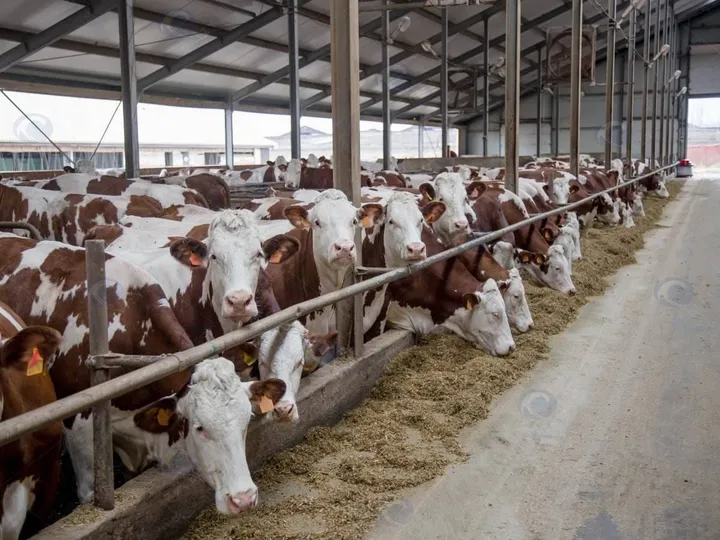
South Africa has a well-developed livestock sector. Dairy farming is concentrated in KwaZulu-Natal, the Western Cape, the Eastern Cape, and the Free State. Beef cattle and sheep operations cover large parts of the country, from the Highveld to the semi-arid Karoo.
Feed costs are one of the largest expenses for any livestock business. When cattle can sort feed, they leave behind the less palatable parts of the ration. This leads to wasted feed, unbalanced nutrition, and lower production. A vertical TMR feed mixer solves this by cutting long fibers into short, uniform lengths and blending all ingredients together.
Compared with manual mixing, a TMR feed mixer can:
- Replace the work of 20 or more laborers
- Reduce feed waste by 5–10%
- Increase dry matter intake
- Improve milk yield in dairy herds
- Support faster growth rates in beef cattle
For South African conditions, the machine must also handle common local feeds such as maize silage, lucerne hay, teff, oat hay, Rhodes grass, and straw.
What Should You Consider When Buying a Vertical TMR Feed Mixer in South Africa?
Power Supply and Motor Voltage
South Africa uses 230V single-phase et 400V three-phase electricity at 50 Hz. Most stationary vertical TMR feed mixers above 5 m³ need a three-phase 400V supply because the main motors range from 18.5 kW to more than 110 kW.
When you order a vertical TMR feed mixer for sale in South Africa, confirm the following with the supplier:
- Motor voltage: 380V/400V three-phase, 50 Hz
- Control panel voltage: 220V/230V
- Whether the motor is rated for 50 Hz (some Chinese factories default to 60 Hz for export)
- Protection rating of electrical boxes for dusty farm environments
Taizy supplies machines configured for South African voltage on request.
Diesel vs Electric vs PTO for Load Shedding
South Africa experiences regular load shedding. This makes power reliability a major factor when choosing a TMR mixer.
- Electric-hydraulic models are the cheapest to run if you have stable three-phase power. They are quiet, clean, and ideal for indoor feed rooms. However, they stop working during load shedding unless you have a generator.
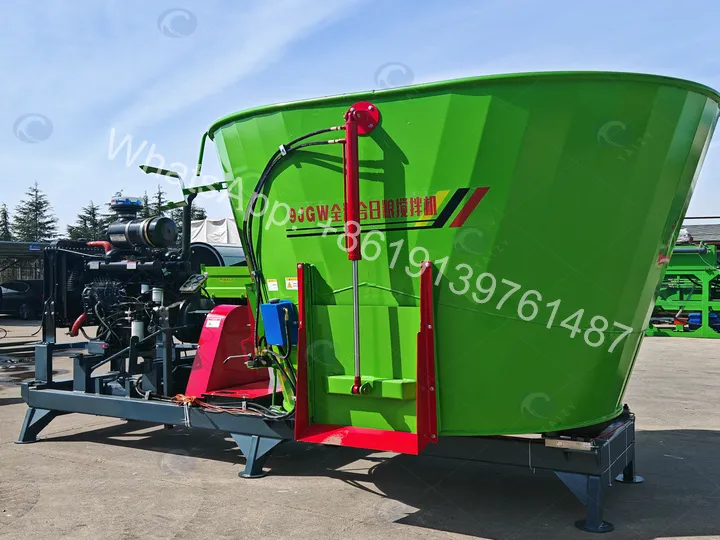
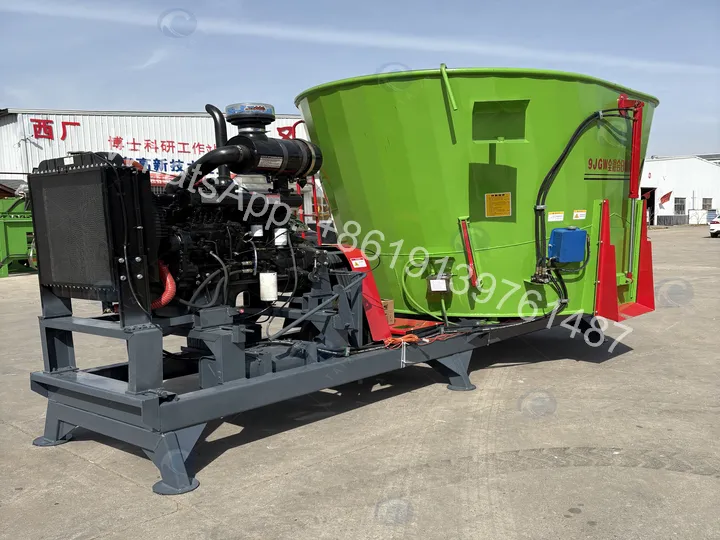
- Diesel engine models are fully independent. They work anywhere on the farm and keep running during power cuts. They cost more to fuel than electric models, but they protect your feeding schedule when the grid fails.
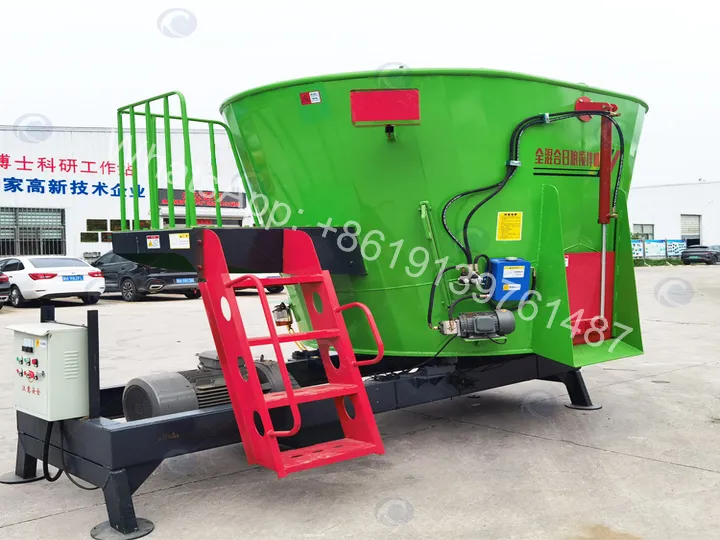
- Tractor PTO models use your existing tractor. They are mobile and do not rely on the farm’s electrical supply. If you already own a 70–170 HP tractor, this can be the most cost-effective option.
For South African buyers, diesel or PTO drive is often the safer long-term choice because feeding cannot wait for Eskom.
Capacity for Your Herd Size
Choose capacity based on the number of animals and how often you want to mix.
| Herd Size | Capacité recommandée | Typical Model |
|---|---|---|
| 50–150 head | 3–6 m³ | Small stationary or tractor-towed |
| 150–400 head | 7–12 m³ | Mid-size stationary or towed |
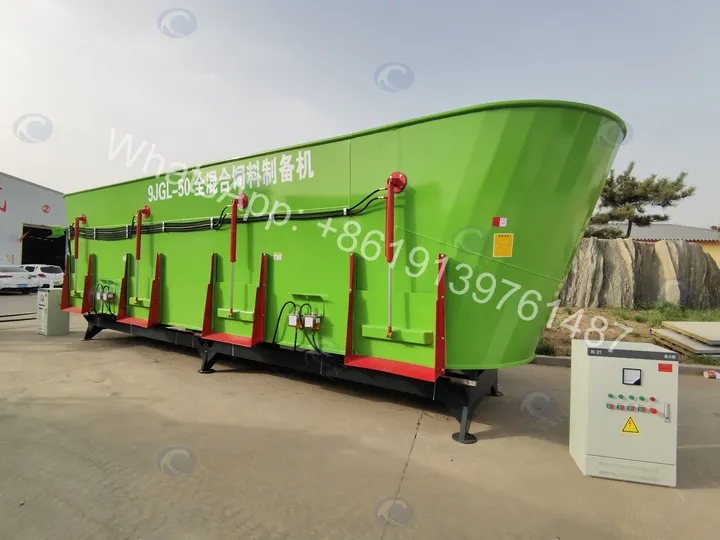
| 400–1,000 head | 15–24 m³ | Large stationary TMR mixer |
| 1,000+ head | 24–36 m³ | Large capacity TMR mixer |
Remember that dry matter density is lower for silage and hay than for concentrate. A 12 m³ mixer may handle 2,500–4,500 kg per batch, depending on the recipe.
Mobility for Your Farm Layout
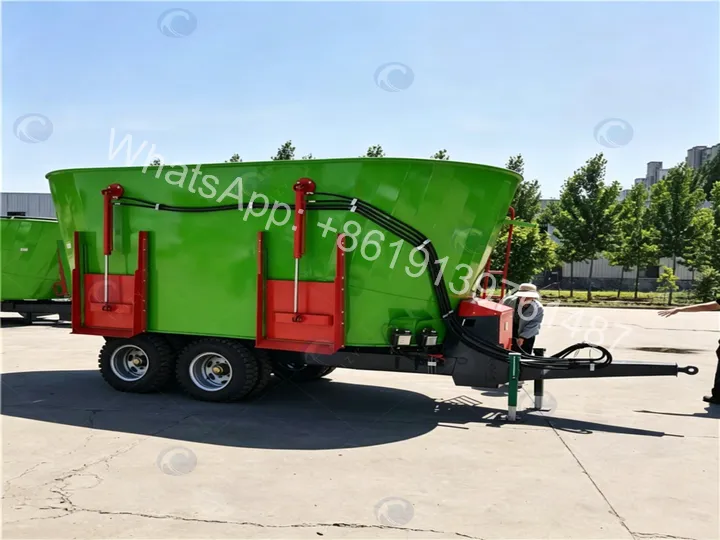
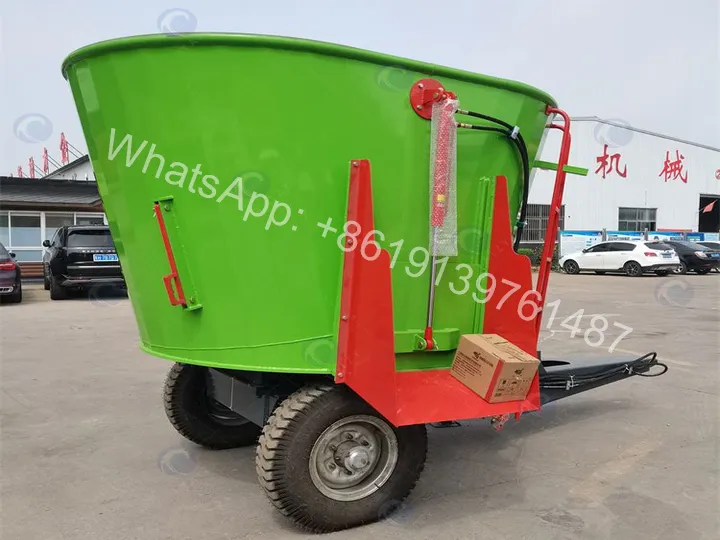
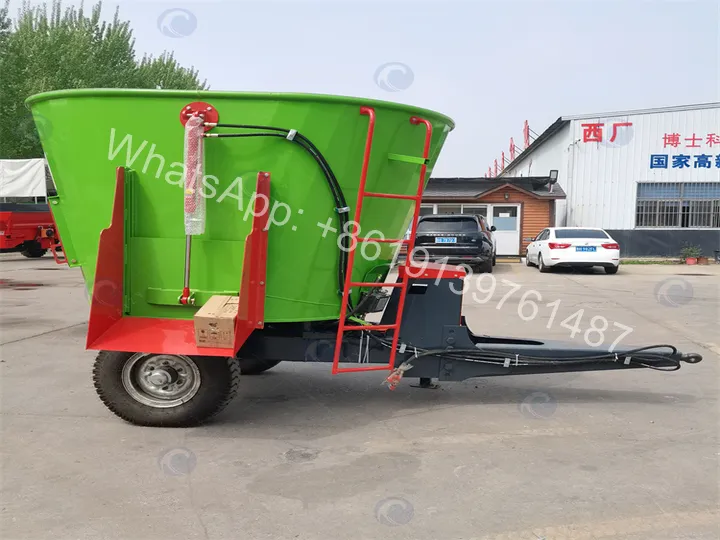
If your cattle are spread across multiple camps or you feed in open lots, a tractor-towed TMR feed processing mixer is more practical. It can be mixed in the yard and driven directly to the feed fence.
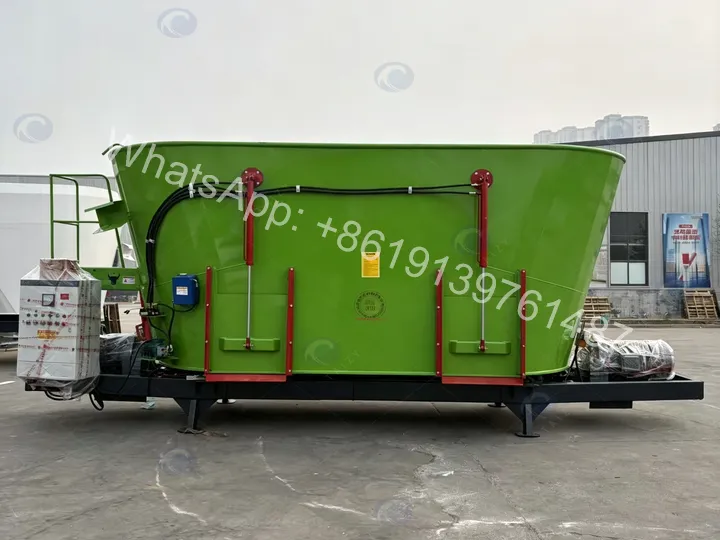
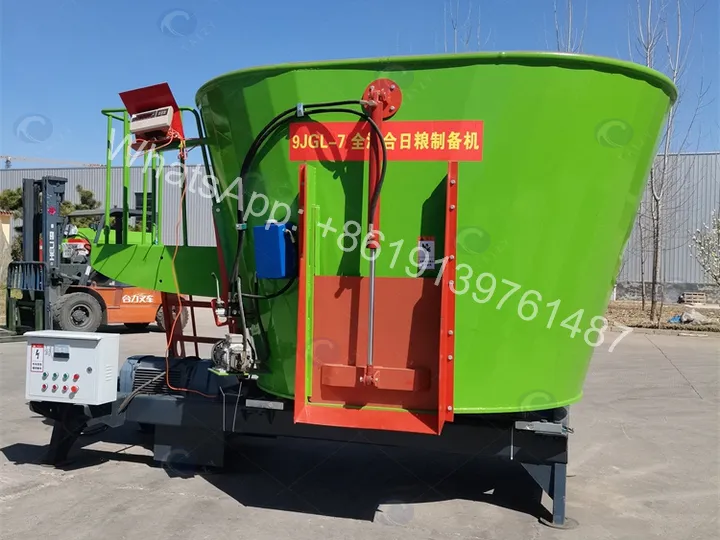
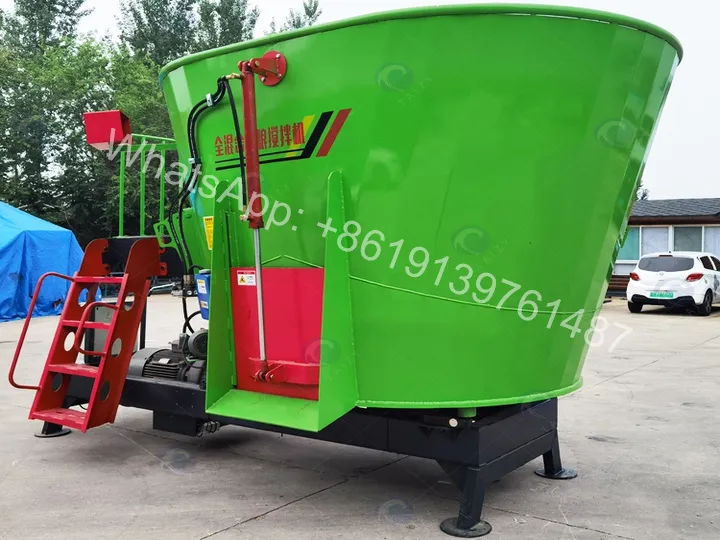
If your operation is based around a fixed dairy or feedlot, a stationary vertical TMR feed mixer is usually more efficient. It sits in a feed room, receives ingredients by loader, and discharges into a feed cart or conveyor.
Vertical vs Horizontal TMR Mixer: Which Is Better for South African Farms?
Both designs mix TMR, but they suit different farms.
A vertical feed mixer uses upright augers to pull feed down and cut it against fixed knives. It handles long-fiber materials like silage and hay bales very well. It is also easier to load with a front loader because the opening is wide and high.
A horizontal feed mixer uses paddles or augers rotating on a horizontal axis. It mixes faster and uses less power for short-fiber rations, but it can struggle with whole round bales and long straw.
For South African farms that use a lot of silage, hay, and straw, the vertical TMR feed mixer is usually the better choice.
What Voltage and Electrical Requirements Should You Check Before Buying a TMR Mixer in South Africa?
South Africa’s electrical installation standards follow SANS 10142. For agricultural equipment, the following points matter:
- Standard voltage: 230V single-phase / 400V three-phase
- Frequency: 50 Hz
- Socket type: Type M (three round pins, 15A) is the national standard for heavy-duty and industrial equipment. Type C plugs are also common for smaller appliances. Large machines are usually hardwired into a distribution board rather than plugged in.
- Cable sizing: Three-phase motors above 18.5 kW need appropriately sized copper cable and proper circuit breakers.
- Earthing: All metal frames must be properly earthed to farm earth spikes.
Before installation, have a qualified electrician check the supply capacity. A 37 kW motor can draw around 70 amps per phase at full load, so the farm supply and cables must be rated for it.
How Much Does a Vertical TMR Feed Mixing Machine Cost in South Africa?
Prices depend on capacity, power system, materials, and optional equipment such as weighing systems, discharge conveyors, and extra blades.We recommend contacting the original manufacturer directly for a quotation, as prices may vary from one supplier to another. You can choose the most suitable machine according to your budget. The prices listed below are for reference only.
If you would like to request a quotation from Taizy, please leave your inquiry in the contact form on the right. We will get back to you within 24 hours.
As a general guide:
- Small 5–7 m³ stationary electric models: from around 5,000–10,000 USD
- Mid-size 12–18 m³ models: from around 10,000–20,000 USD
- Large 24–36 m³ stationary models: from around 30,000–40,000+ USD
- Tractor-towed 6–20 m³ models: from around 5,000–20,000 USD
Import duties, VAT at 15%, port handling, and inland transport from Durban or Cape Town will add to the landed cost. Request a full CIF or DAP quote so you can compare the true delivered price in ZAR.
How Is a Vertical TMR Feed Mixer Shipped and Delivered to South Africa?
Most vertical TMR feed mixers ship from China to South Africa by sea. The main ports are:
- Durban (closest to Johannesburg and inland farms)
- Cape Town (best for Western Cape agriculture)
- Port Elizabeth / Gqeberha (useful for Eastern Cape buyers)
Sea freight typically takes 25–35 days. After arrival, the machine must clear customs, pay import duty and VAT, and then travel by truck to your farm. Full assembly is usually minimal because the mixer arrives as one unit.
Taizy provides:
- Export packing in steel frames or wooden crates
- Commercial invoice, packing list, bill of lading, and certificate of origin
- Motor nameplate matched to South African voltage
- English operation manual and electrical diagrams
Best Applications in South African Farming
A vertical TMR feed mixer is suitable for many South African livestock systems:
- Dairy farms in KwaZulu-Natal and the Western Cape are feeding maize silage and lucerne
- Beef feedlots in the Free State and North West are mixing high-roughage rations
- Sheep and goat farms in the Karoo and Eastern Cape are blending teff, oat hay, and concentrate
- Commercial feed contractors serving multiple farms
- Feedlots preparing backgrounding rations for weaners
The machine handles dry hay, silage, straw, and concentrate in one batch. This makes it one of the most versatile pieces of equipment on a livestock farm.
How Do You Choose the Right Vertical TMR Feed Mixing Machine for Your Farm in South Africa?
A vertical TMR feed mixer for sale in South Africa can transform feeding efficiency on dairy, beef, and sheep farms. The key is choosing the right power system for local conditions, the right capacity for your herd, and a supplier who understands South African voltage, plugs, and logistics.
Whether you need a stationary model for a fixed dairy or a tractor-towed unit for grazing camps, Taizy can configure the machine for 400V/50 Hz operation and arrange delivery to Durban, Cape Town, or Johannesburg.
Ready to buy a vertical TMR feed mixer in South Africa? Contact Taizy today for a free quote, delivery timeline, and full technical specifications.