Vertical TMR Feed Mixer | Stationary & Tractor-Towed Models for Dairy & Cattle Farms
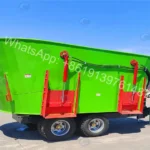
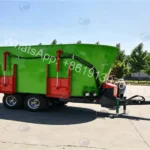
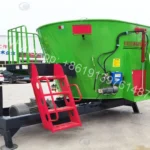
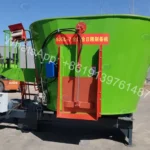
| Marca | Taizy Machinery |
| Modello | 9JGL Series |
| Structural Type | Stationary / PTO-Driven |
| Power Options | Electric Motor / Diesel Engine / Hydraulic Drive |
| Hopper Capacity | 3–36 m³ |
| Working Capacity | 1,500–10,000 kg/h |
| Number of Augers | 1–3 |
| Number of Discharge Outlets | 1–2 |
| Main Motor Power | 18.5–111 kW |
| Discharge Motor Power | 1.5 kW |
| Velocità dell'albero principale | 23 r/min |
| Tank Steel Plate Thickness | 6–10 mm |
| Bottom Steel Plate Thickness | 14–25 mm |
| Auger Steel Plate Thickness | 16 mm |
| Blade Type | Triangular Blades with Fixed Small Blades |
| Blade Material | Cr12MoV |
| Tank Material | Q345B Steel |
| Weighing System | Integrated Digital Weighing System |
| Materiali applicabili | Silage, Hay, Straw, Grass, Corn Stalks, and Other Roughage |
| Applicazione | Dairy Farms, Beef Farms, Feedlots, and Livestock Feed Processing |
| Warranty Period | 1 year |
Ora puoi chiedere ai nostri project manager dettagli tecnici
A vertical TMR feed mixer is a self-contained feed processing machine that chops, mixes, and blends roughage, concentrate feed, minerals, vitamins, and additives into one balanced Total Mixed Ration. It is also known as a TMR feed mixer, TMR feed preparation machine, TMR feed mixing machine, or simply a TMR mixer.
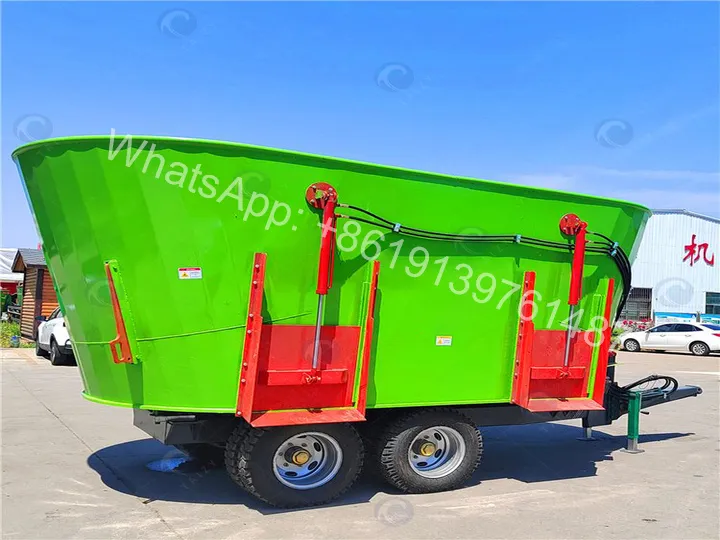
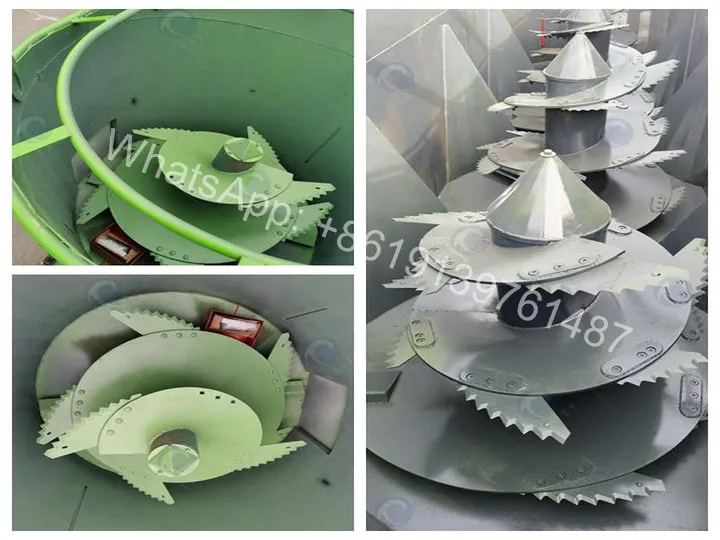
The vertical design mounts one or more augers inside an upright mixing tub. As the augers rotate, long-fiber materials such as corn silage, hay bales, and straw are pulled downward, cut by hardened blades, lifted, and recirculated. This continuous action produces a uniform blend that prevents cattle from sorting feed and leaving the least palatable ingredients behind.
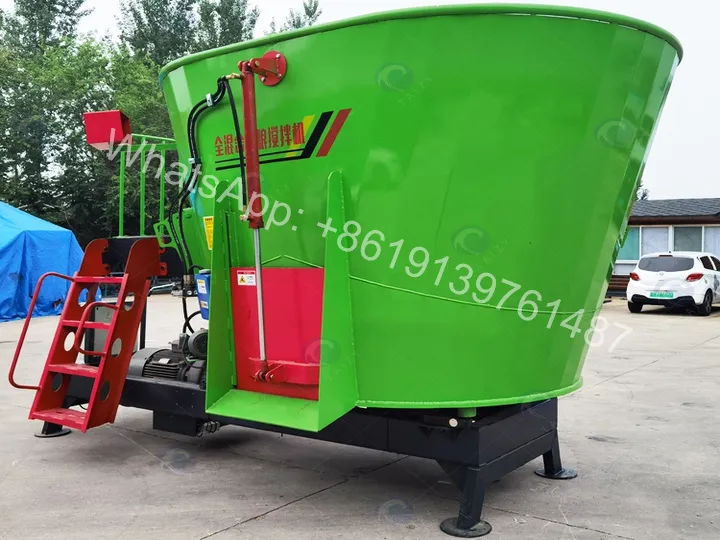
Taizy builds vertical TMR feed mixers in capacities from 3 m³ to 36 m³. Small models can serve 200–250 head per day, while large-capacity TMR mixers can prepare ration for 2,000 head or more. The typical batch cycle runs 15–20 minutes, so a single unit can replace the manual work of 20 or more laborers.
What Is the Difference Between Stationary and Tractor-Towed Vertical TMR Feed Mixers?
Taizy supplies two structural types to match different farm layouts and feeding routines.
Stationary Vertical TMR Feed Mixer
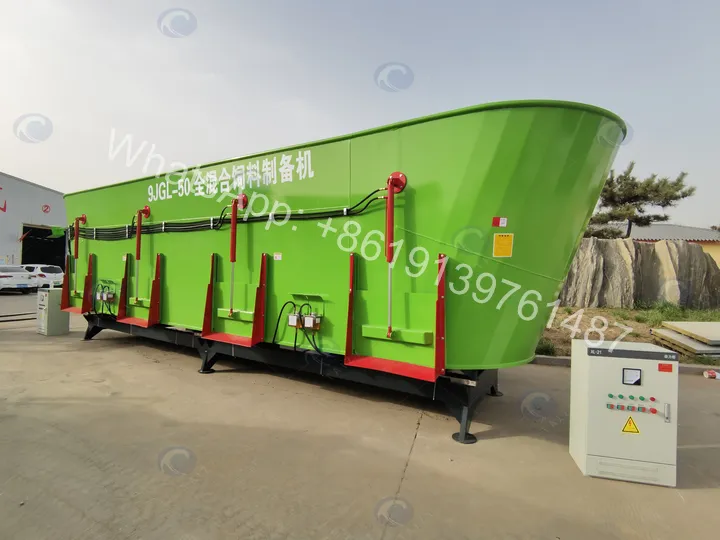
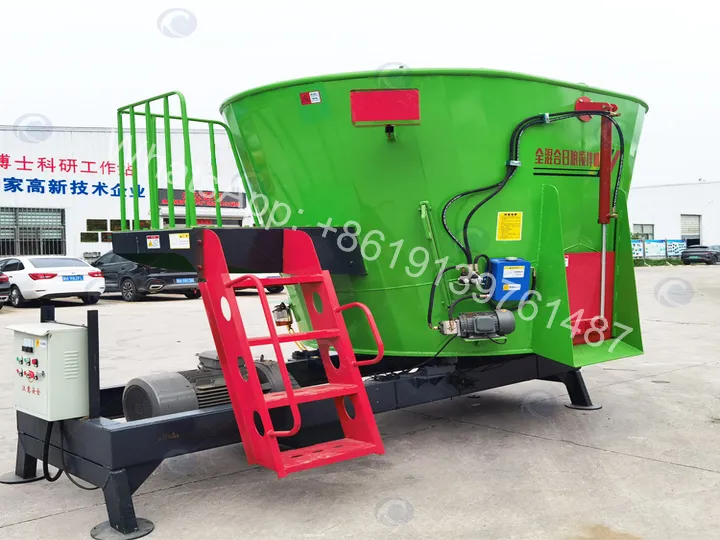
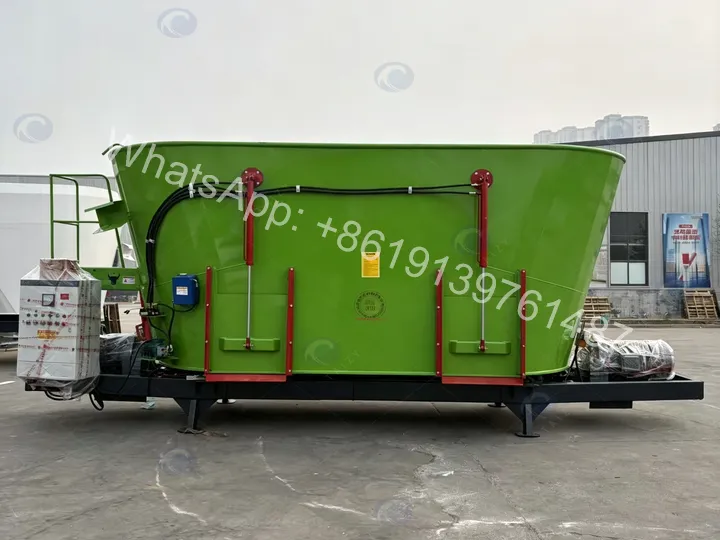
A stationary vertical TMR feed mixer is installed on a concrete pad inside a feed room or feed center. It is loaded by front loader, conveyor, or bale handler and discharges the finished ration into a cart, conveyor, or directly into the feed alley.
This configuration suits:
- Fixed dairy barns with centralized feed kitchens
- Beef feedlots that prepare ration at one point
- Commercial feed centers serving multiple farms
- Operations with reliable grid power or a standby generator
Stationary models are available with hopper capacities from 5 m³ to 36 m³ and working capacities from 1,500 kg/h to 10,000 kg/h.
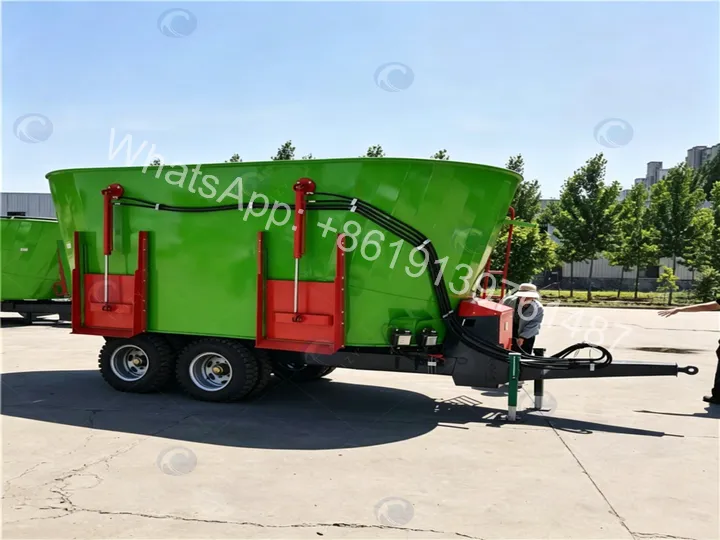
Tractor-Towed Vertical TMR Feed Mixer
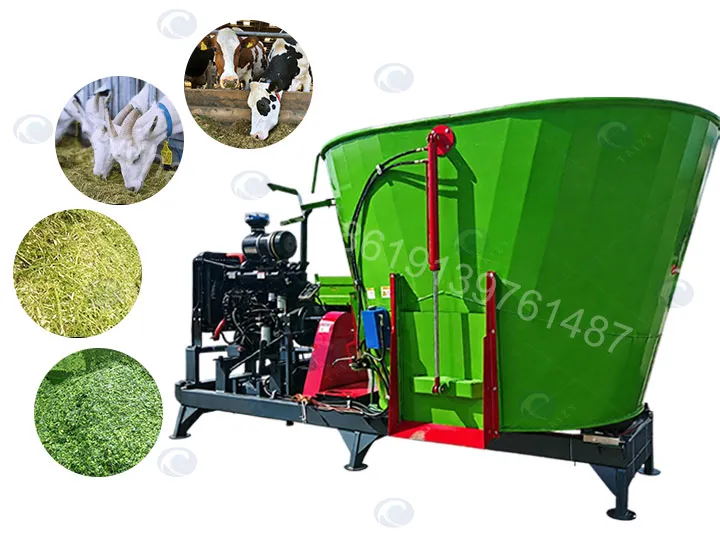
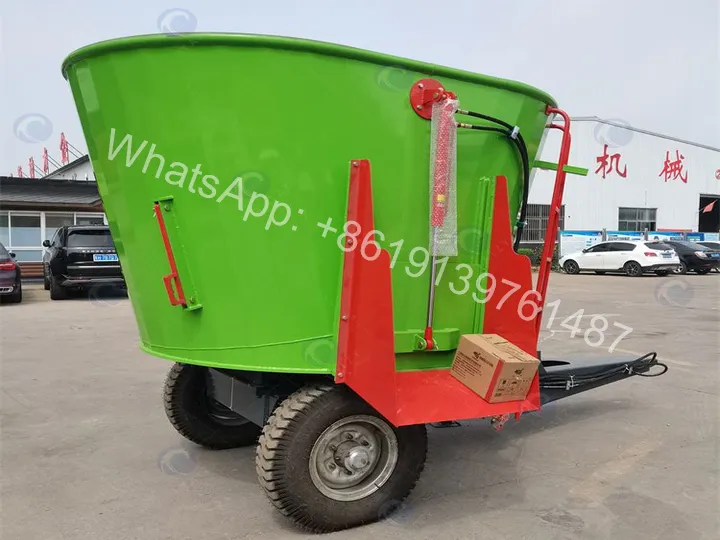
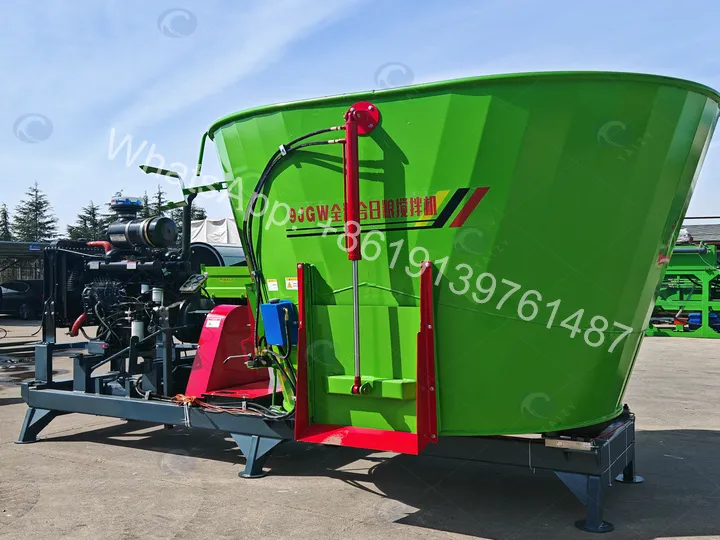
A tractor-towed vertical TMR feed mixer is mounted on a heavy-duty chassis with wheels. It is hitched to a tractor and driven by the tractor PTO, or it can carry its own diesel engine and hydraulic system. This mobility lets operators mix feed in the yard and discharge it along feed fences or in open lots.
This configuration suits:
- Grazing dairy and beef operations
- Farms with multiple barns or remote paddocks
- Contractors who prepare feed at different customer sites
- Operations that want to avoid building a fixed feed room
Tractor-towed models range from 6 m³ to 20 m³, with working capacities from 1,700 kg/h to 4,500 kg/h.
What Power Options Are Available for a Vertical TMR Feed Mixer?
Taizy vertical TMR feed mixers are offered with three power systems. Each has clear advantages depending on your farm infrastructure.
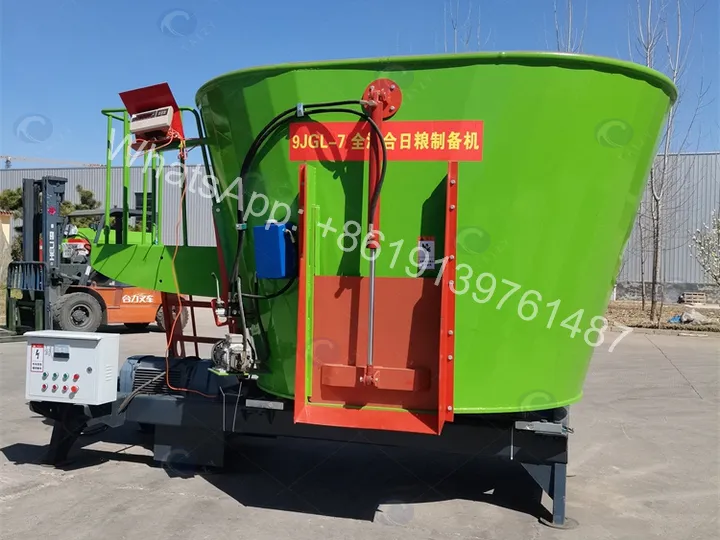
Electric-Hydraulic Drive
Electric-hydraulic models use an electric motor to turn the augers and a hydraulic cylinder to control the discharge door.
Advantages:
- Lower operating cost where grid power is available
- Quiet, clean operation suitable for indoor feed rooms
- Precise hydraulic door control for measured discharge
- Easy integration with automatic weighing and recipe control
Diesel Engine Drive
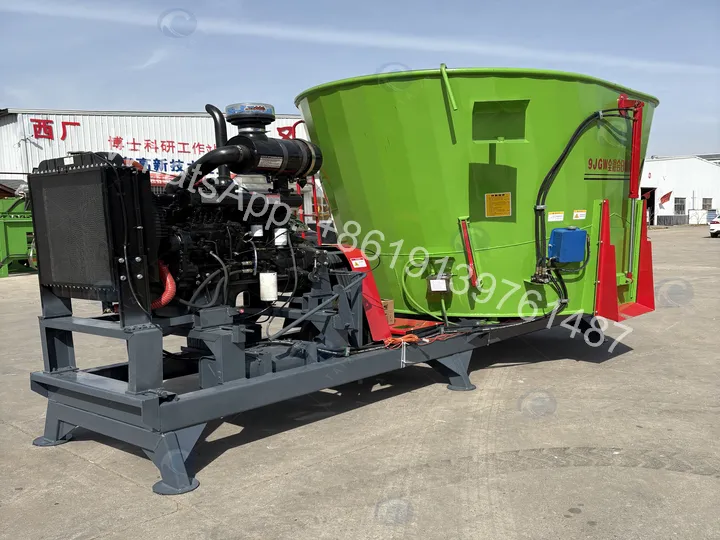
Diesel-powered models carry their own engine and hydraulic system. They do not depend on a tractor or external electricity.
Advantages:
- Fully mobile, works in any yard or remote location
- No PTO tractor required
- Reliable cold-start performance
- Ideal for contractors and farms without three-phase power
Tractor PTO Drive
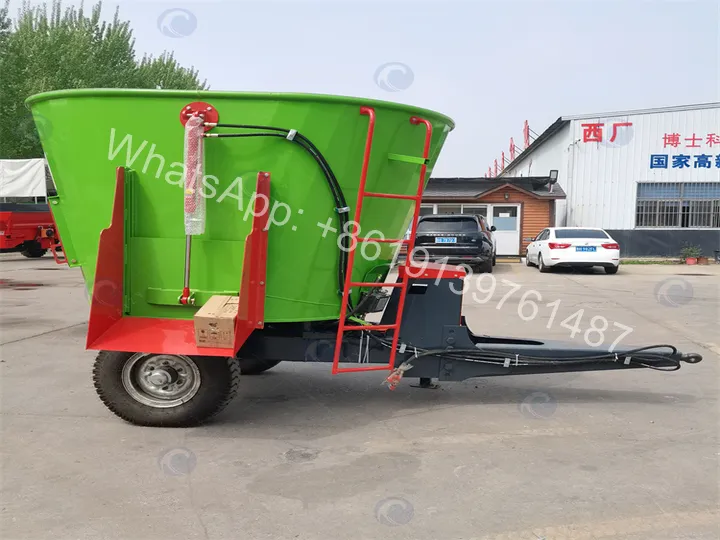
PTO-driven models use the tractor’s power take-off shaft to rotate the augers. They are the most common choice for tractor-towed machines.
Advantages:
- Lowest capital cost for farms that already own a suitable tractor
- Direct mechanical drive, simple and efficient
- Easy to move and position at the feed fence
- No separate engine to maintain
How Does the Vertical TMR Feed Mixer work?
The mixing tub contains one, two, or three vertical augers. Each auger has left-hand and right-hand spiral flights. During operation, feed moves from both ends of the tub toward the center.
Hardened blades mounted on the auger flights work against fixed knives along the centerline. This cutting action shortens long fibers such as corn silage, hay, and straw while blending them with concentrates and additives.
The cycle repeats until the ration reaches the desired particle length and uniformity. A weighing system with four load cells displays gross weight, net weight, peak weight, and weight change, and it includes an overload alarm to protect the gearbox and motor.
The discharge system uses a hydraulic cylinder, fixed support, linkage support, and sliding discharge gate. A high-strength magnetic plate removes ferrous contaminants before the ration leaves the machine. The discharge gate can be positioned on the left or right side to match your layout.
Key Advantages for Dairy and Beef Operations
Using a vertical TMR feed mixer on a dairy or cattle farm delivers measurable production benefits:
- Prevents selective feeding: Every bite contains the same roughage, concentrate, and additives.
- Improves dry matter intake: Cattle eat more when feed is uniform and palatable.
- Supports higher milk yield: Balanced nutrition meets the energy and protein needs of lactating cows.
- Reduces mineral and vitamin deficiencies: Additives are evenly distributed, lowering the risk of deficiency or toxicity.
- Cuts feed waste: Less sorting means less leftover feed in the trough.
- Saves labor: One machine can replace more than 20 workers.
- Long service life: The tub is built from Q345B steel, the bottom plate is reinforced up to 25 mm, and blades are Cr12MoV alloy steel.
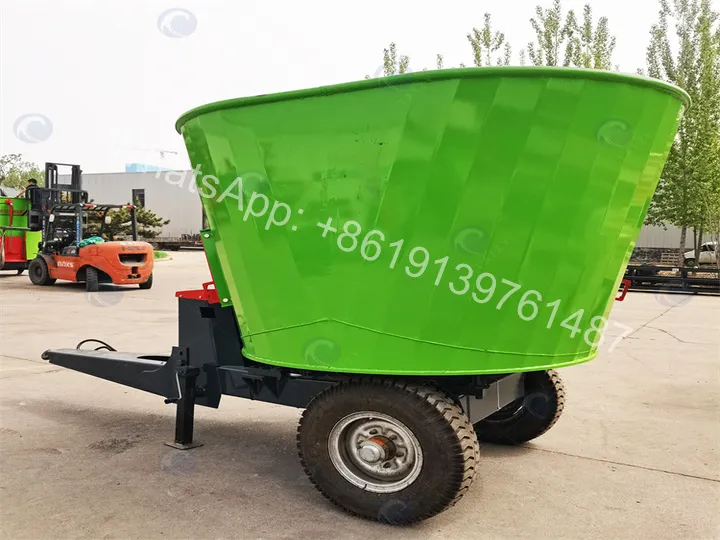
Stationary Vertical TMR Feed Mixer Specifications
| Voce | Unit | 9JGL-5 (5 m³) | 9JGL-7 (7 m³) | 9JGL-12 (12 m³) | 9JGL-18 (18 m³) | 9JGL-24 (24 m³) | 9JGL-36 (36 m³) |
|---|---|---|---|---|---|---|---|
| Structural Tipo | / | Stationary Vertical Type | Stationary Vertical Type | Stationary Vertical Type | Stationary Vertical Type | Stationary Vertical Type | Stationary Vertical Type |
| Hopper Capacità | m³ | 5 | 7 | 12 | 18 | 24 | 36 |
| Overall Dimensioni (L × W × H) | mm | 3400 × 2100 × 2100 | 3800 × 2600 × 2500 | 4000 × 2250 × 2700 | 6100 × 2400 × 2700 | 6900 × 2500 × 3000 | 8300 × 3350 × 2650 |
| Machine Peso | kg | 2000 | ≥1650 | 3800 | – | – | – |
| Main Motor Potenza | kW | 18.5 | 18.5 | 37 | 2 × 30 | 2 × 37 | 3 × 37 |
| Discharge Potenza del motore | kW | 1.5 | 1.5 | 1.5 | 1.5 | 1.5 | 1.5 |
| Main Shaft Speed | r/min | 23 | 23 | 23 | 23 | 23 | 23 |
| Working Capacità | kg/h | 1500–2500 | 3000-4000 | 4000–4500 | 6000–10000 | 6000–7000 | 8000–10000 |
| Number of Discharge Outlets | pcs | 1 | 1 | 1 | 1 | 1 | 2 |
| Number of Augers | pcs | 1 | 1 | 1 | 2 | 2 | 3 |
| Tank Steel Plate Thickness | mm | 6 | 6 | 8 | 8 | 8 | 10 |
| Bottom Steel Plate Thickness | mm | 14 | 14 | 20 | 20 | 20 | 25 |
| Auger Steel Plate Thickness | mm | 16 | 16 | 16 | 16 | 16 | 16 |
| Blade | pcs | Triangular Blades, Small Blades FixedBladess | Triangular Blades, Small Blades Fixed Blades | Triangular Blades, Small Blades Fixed Blades | Triangular Blades, Small Blades FixedBladess | Triangular Blades, Small Blades Fixed Blades | Triangular Blades, Small Blades Fixed Blades |
| Blade Materiale | / | Cr12MoV | Cr12MoV | Cr12MoV | Cr12MoV | Cr12MoV | Cr12MoV |
| Steel Plate Materiale | / | Q345B | Q345B | Q345B | Q345B | Q345B | Q345B |
| Weighing System | set | 1 | 1 | 1 | 1 | 1 | 1 |
| Gearbox Marca | / | Jiangling | Jiangling | Jiangling | Jiangling | Jiangling | Jiangling |
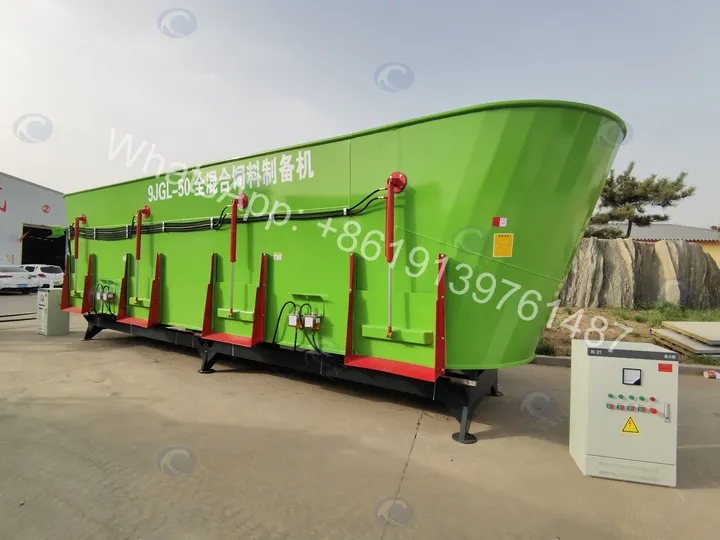
Tractor-Towed Vertical TMR Feed Mixer Specifications
| Voce | Unit | 9JGLQ-6 (6 m³) | 9JGL-7 (7 m³) | 9JQL-9 (9 m³) | 9JGL-15 (15 m³) | 9JGL-20 ( 20 m³) |
|---|---|---|---|---|---|---|
| Structural Type | / | Vertical Traction Tipo | Vertical Traction Tipo | Vertical Traction Tipo | Vertical Traction Tipo | Vertical Traction Tipo |
| Hopper Capacità | m³ | 6 | 7 | 9 | 15 | 20 |
| Overall Dimensioni (L × W × H) | mm | 3700 × 2200 × 2400 | 3700 × 2200 × 2300 | 3800 × 2200 × 2450 | 6500 × 2350 × 2600 | 6500 × 2200 × 2500 |
| Top Opening (L × W) | mm | 2600 × 1800 | 2700 × 2100 | 2800 × 2100 | – | – |
| Machine Peso | kg | 2100 | – | – | 4500 | – |
| Number of Discharge Outlets | pcs | 1 | 1 | 1 | 2 | 2 |
| Main Shaft Speed | r/min | 23 | 23 | 23 | 23 | 23 |
| Large Triangular Lame | pcs | 5 | 7 | 8 | 14 | 14 |
| Small Blades | pcs | 4 | 6 | 7 | 10 | – |
| Fixed Blades | pcs | 2 | – | – | 2 | – |
| Blade Material | Cr12MoV | Cr12MoV | Cr12MoV | Cr12MoV | Cr12MoV | Cr12MoV |
| Steel Plate Materiale | Q345B | Q345B | Q345B | Q345B | Q345B | Q345B |
| Tank Steel Plate Thickness | mm | – | Side 8, Bottom 20 | Side 8, Bottom 20 | Tank 8, Bottom 20, Auger 14 | – |
| Weighing System | set | 1 | 1 | 1 | 1 | 1 |
| Power Match | 70+ HP tractor | 70 HP tractor, rear PTO | 70+ HP tractor | 70+ HP tractor | 90+ HP tractor | >170 HP, rear output 800 r/min |
| Gearbox Brand | Jiangling | Jiangling | Jiangling | Jiangling | Jiangling | Jiangling |
| Number of Drive Shafts | pcs | – | – | – | – | Wide-angle PTO shaft, 540 r/min input |
| Drive Type | Tractor rear PTO | Tractor rear PTO | Tractor rear PTO | Tractor rear PTO | Tractor rear PTO | Mechanical drive |
| Tire Specifiche | / | – | – | – | – | 275/70/R22.5, 4 pcs |
| Working Capacità | kg/h | 1700–2700 | 3000–4000 | 3000–4000 | 4000–4500 | 6000-6500 |
What Feed Materials and Farm Applications Are Suitable for a Vertical TMR Feed Mixing Machine?
A vertical TMR feed mixer handles a wide range of feed ingredients:
- Corn silage and grass silage
- Dry hay and hay bales
- Straw and chaff
- Concentrate feed and premix
- Minerals, vitamins, and molasses
- Beet pulp and other by-products
Typical users include:
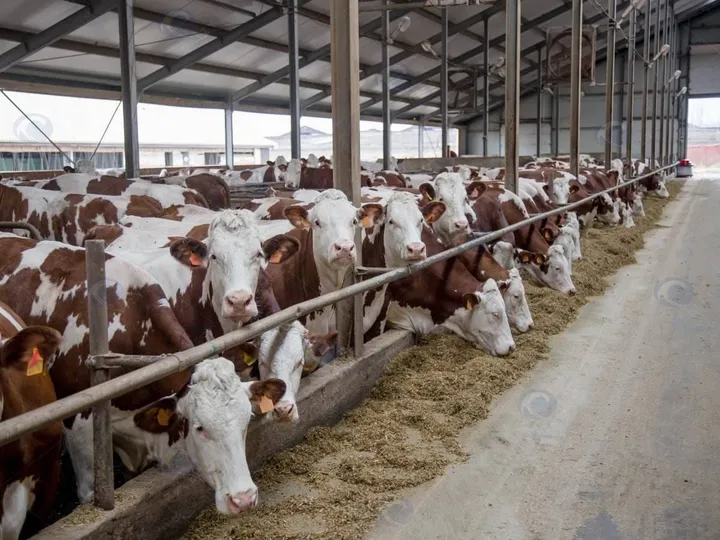
- Dairy farms with 200 to 2,000+ cows
- Beef cattle feedlots
- Sheep and goat farms
- Commercial livestock enterprises
- Custom feed mixing contractors
Why Choose Taizy?
Taizy has supplied feed processing machinery to farms and cooperatives for more than 20 years. Every vertical TMR feed mixer is engineered with reinforced steel construction, precision-machined augers, and industrial-grade gearboxes.
What you get with Taizy:
- Factory-direct pricing for vertical TMR feed mixers
- Customizable hopper capacity, discharge position, and power system
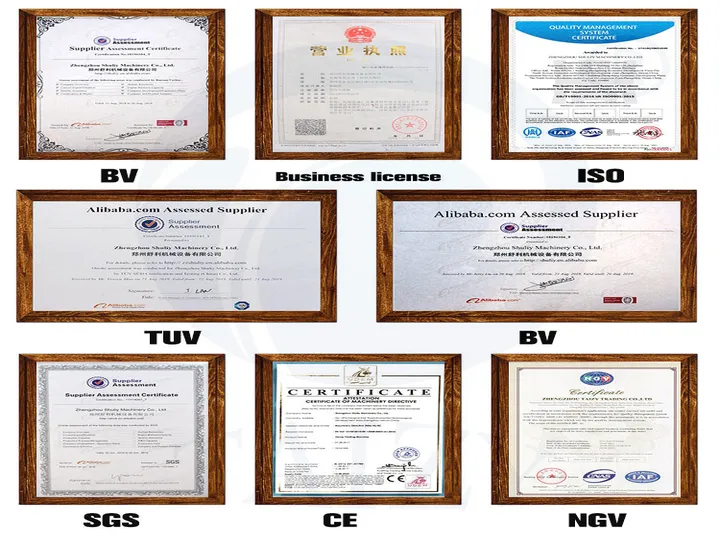
- ISO and CE-certified manufacturing
- One-year warranty on core components
- 24-hour technical support response
- Team di servizi multilingue
Frequently Asked Questions (FAQ)
What tractor size do I need for a PTO-driven vertical TMR feed mixer?
Small 6–9 m³ models generally require a 70–90 HP tractor with rear PTO. The 15 m³ model needs 90+ HP, and the 20 m³ heavy-duty model requires more than 170 HP with a rear output speed of 800 r/min.
How long do the blades last on a TMR feed mixer?
Blade life depends on the feed materials and operating hours. Cr12MoV alloy blades on Taizy mixers are hardened for wear resistance. Most users inspect blades every 500–1,000 operating hours and replace them when cutting performance drops or edges show significant wear.
Can the vertical feed mixer process whole round bales?
Yes, but bales should be opened or partially broken before loading. Whole round bales can overload the auger and extend mixing time. Removing twine or net wrap is essential to prevent damage to blades and wrapping around the shaft.
What electrical supply is needed for stationary electric models?
Most stationary models use standard three-phase industrial power. For example, the 5 m³ and 7 m³ units run on an 18.5 kW main motor plus a 1.5 kW discharge motor. Confirm your local voltage and frequency before ordering.
How do I clean the mixer between batches?
Run the auger empty for one to two minutes after discharge to clear residual feed. For thorough cleaning, lower the discharge gate, rinse the tub with water, and allow it to drain. Regular cleaning prevents mold growth and cross-contamination between rations.
Is the weighing system accurate enough for ration formulation?
Yes. The four-point load cell system displays gross weight, net weight, peak weight, and weight change. It is accurate enough for daily TMR recipes and includes an overload alarm to protect the machine.
Can I add liquid molasses or other additives during mixing?
Yes. Liquid additives can be poured through the top opening during the mixing cycle. For large volumes, an optional liquid dosing pump can be connected to add molasses, oils, or enzymes evenly throughout the ration.
What is the typical delivery time for a vertical TMR feed mixer?
Standard models are usually ready for shipment within 7–15 working days after order confirmation. Custom configurations, such as special voltage, additional discharge conveyors, or extra-large capacity, may need 20–30 working days.
Related Equipment –Grandi Tritacarne per Steli di Mais
This 9RSZ‑series heavy‑duty forage chopper covers four standard models, achieving hourly processing capacity of 4‑20 tons with total installed power ranging from 7.5kW to 34kW. It adopts heavy‑duty welded steel frame, fitted with alloy serrated hammer‑blade assemblies and automatic chain‑plate feeding conveyor. Main spindle speed reaches 2100‑2860 rpm, with throwing discharge distance over 2300 mm. It handles both dry and fresh corn stalks, sorghum stalks, alfalfa, elephant grass and various hay forage. Equipped with enclosed cutting chamber and independent electric control cabinet, it outputs evenly shredded fine forage, suitable for silage fermentation and livestock feeding for large‑scale farms, feed processing plants and agricultural cooperatives.
Vantaggi chiave
- Broad Forage Raw‑Material Compatibility: Processes dry and green corn stalk, sorghum stalk, alfalfa, elephant grass and other coarse fodder; well‑adapted for silage making and direct livestock feeding.
- High‑Volume Batch Processing: Tiered‑capacity models fit small farms up to large commercial breeding bases; automatic continuous feeding only requires 1‑2 operators to cut heavy manual workload.
- High‑Strength Hammer‑Blade Shredding System: Multiple groups of wear‑resistant alloy serrated blades deliver uniform fine‑cut forage, breaking tough plant fibres and improving livestock digestibility and feed palatability.
- Safe Automatic Conveyor Feeding Design: Chain‑plate auto‑feeding keeps operators away from high‑speed cutting cavity, effectively lowering injury risks during long‑time continuous operation.
- Long‑Distance Direct Discharge: ≥2300 mm throwing distance directly sends shredded forage to trucks, silage pits or storage bins, reducing secondary material handling steps.
- Robust Low‑Maintenance Construction: Reinforced whole‑machine frame resists heavy‑load shock; wearing blades are easy to disassemble and replace, lowering daily up‑keep cost.
- Complete Customization & After‑Sales Service: 12‑month full‑machine warranty with online operation guidance and video training; feeding width, power configuration and mobile wheel assembly can be customized for on‑site farm conditions.